
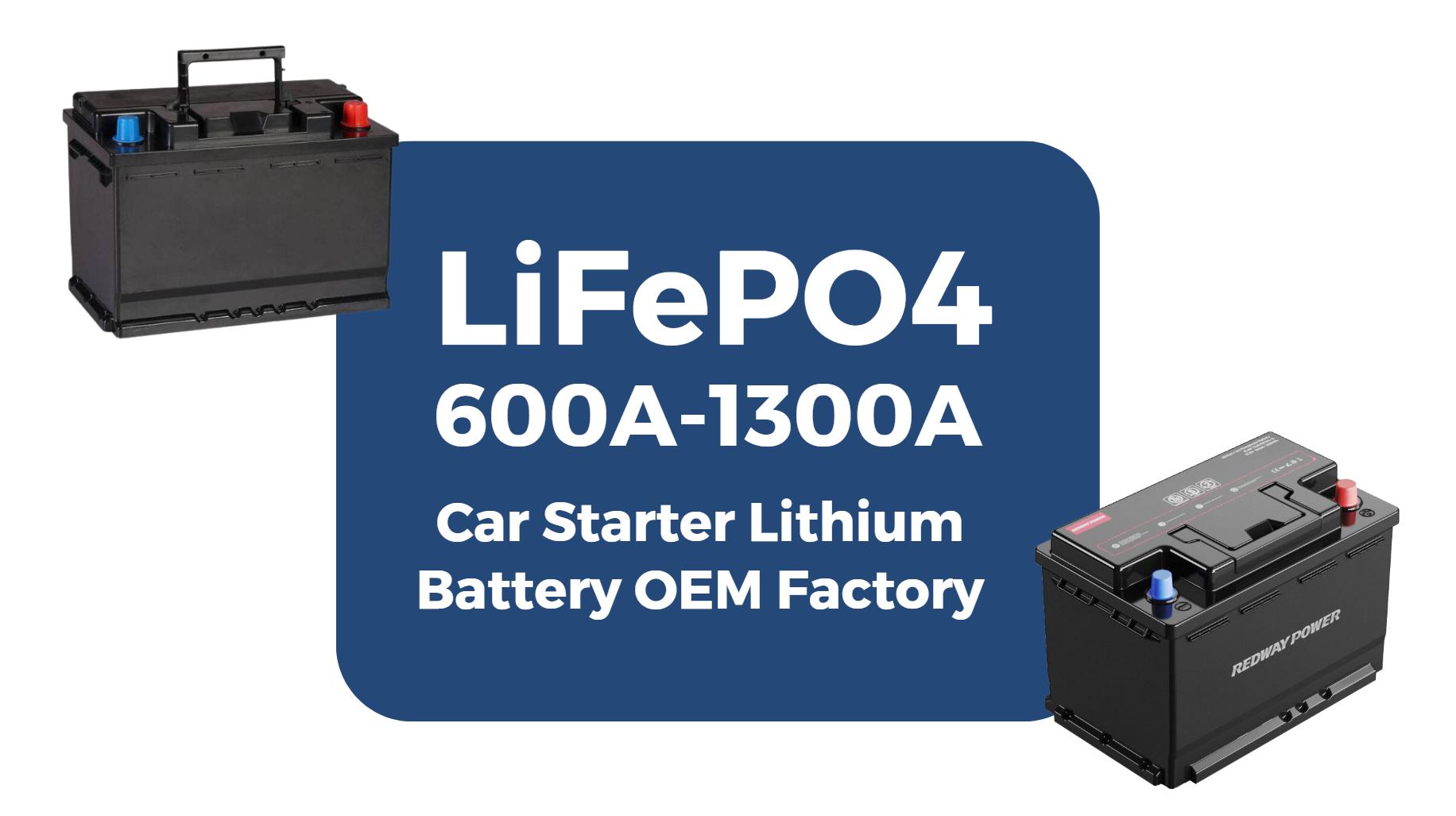
What New Innovations Are Shaping LiFePO4 Car Starter Batteries?
LiFePO4 car starter batteries are advancing with breakthroughs in nanomaterials, smart battery management, and thermal systems that improve power, safety, and lifespan. Companies like Redway ESS lead these innovations, offering reliable, lightweight, and sustainable lithium battery solutions tailored for modern automotive applications. These developments redefine performance, making LiFePO4 the next-generation standard for car starter batteries.
How Do LiFePO4 Batteries Outperform Traditional Lead-Acid Options?
LiFePO4 batteries outperform traditional lead-acid types with longer life cycles, reduced weight, and higher efficiency. They deliver consistent voltage across deep discharges, resist sulfation, and maintain excellent cold-weather performance. Capable of up to 12,000 engine starts—four times more than premium AGM models—they also feature superior vibration resistance, making them ideal for automotive, marine, and heavy-duty use.
| Feature | LiFePO4 | Lead-Acid |
|---|---|---|
| Lifespan | 3–5× longer | Standard |
| Weight | 50% lighter | Heavier |
| Cold Performance | 85–100% capacity at -20°C | 50–70% capacity |
| Self-Discharge | 3% per month | 30% per month |
| Deep Discharge Tolerance | Excellent | Limited |
Redway ESS integrates active balancing circuits and precise BMS technology to extend battery reliability to over 8,000 charge cycles.
What Nanotechnology Breakthroughs Boost LiFePO4 Performance?
Nanotechnology significantly improves LiFePO4 performance. Graphene-coated cathodes expand the surface area by up to 400%, enabling ultra-fast charging within 15 minutes. Silicon-doped anodes enhance lithium diffusion, while carbon nanotube networks reduce internal resistance by 35%. These advances push energy density above 160 Wh/kg—around 40% higher than standard LiFePO4 cells—supporting faster, more powerful engine starts.
Why Are Smart BMS Systems Revolutionizing Battery Reliability?
Modern smart BMS systems use predictive algorithms to detect issues before they cause failure. Adaptive balancing extends lifespan by 30%, while wireless mesh monitoring provides ±0.5°C thermal accuracy. Integration with vehicle ECUs enables optimized charging, particularly during regenerative braking. These intelligent controls maintain stable operation and reduce failure rates by over 80%. Redway ESS employs advanced BMS designs to ensure safety, performance, and consistency.
Which Thermal Management Systems Prevent Overheating?
LiFePO4 batteries use advanced thermal systems such as phase-change materials (PCM), directional thermal interface layers, and pulsed liquid cooling to regulate temperature within ±2°C. These methods prevent overheating, extend lifespan, and ensure stable operation even in extreme climates ranging from -40°C to 75°C.
| Cooling Method | Heat Dissipation | Application Benefit |
|---|---|---|
| PCM Pads | 3× more heat absorption than aluminum | Stable operation in high-heat environments |
| Directional TIM | Efficient heat transfer | Protects sensitive cells |
| Pulsed Liquid Cooling | ±2°C uniform control | Critical for fast-charging applications |
How Are Manufacturers Solving High-Cost Challenges?
Manufacturers are reducing LiFePO4 battery costs through solvent-free electrode processing, automated laser welding, and recycled cathode materials. These innovations cut production costs by up to 40% while improving yield and consistency. With large-scale gigafactories and advanced automation, LiFePO4 technology is expected to match lead-acid pricing by 2026. Redway ESS leverages these strategies to deliver high-performance, cost-effective OEM lithium battery solutions.
What Recycling Innovations Support Sustainability Goals?
Next-generation recycling technologies recover nearly all valuable materials. Hydrometallurgical methods reclaim up to 98% of lithium and 99% of iron phosphate. Direct cathode regeneration restores materials to 99.9% purity using 60% less energy than smelting. Blockchain-based tracking ensures proper recycling and reuse, creating a closed-loop system aligned with environmental and circular economy goals.
Redway ESS Expert Views
“At Redway ESS, we engineer LiFePO4 batteries that unite power, endurance, and environmental responsibility. Through advanced nanomaterials, predictive BMS, and precise thermal control, our products deliver exceptional reliability and performance in demanding conditions. Our commitment to sustainable production and recycling ensures we provide OEM clients with cost-effective, high-quality energy storage solutions for automotive and industrial applications.” — Redway ESS Engineering Team
How Do LiFePO4 Car Starter Batteries Perform in Cold Weather?
LiFePO4 batteries maintain over 80% of their rated capacity at -20°C. Equipped with built-in low-temperature protection and intelligent preheating, they provide reliable starts in cold environments. This makes them ideal for vehicles operating in winter or Arctic conditions, ensuring consistent performance regardless of temperature extremes.
What Extends LiFePO4 Automotive Starter Battery Cycle Life?
The stable lithium-iron-phosphate structure resists degradation and supports 2,000–5,000 full charge cycles. Smart BMS management and balanced charging prevent over-discharge and overcharge, extending usable life beyond 10 years. With no memory effect and minimal corrosion, these batteries deliver long-term performance even under partial charging conditions.
How Does Smart BMS Enhance LiFePO4 Starter Batteries?
Smart BMS systems continuously monitor voltage, current, and temperature. They prevent overcharge above 14.6 V and deep discharge below 8 V while balancing cells for uniform aging. Bluetooth-enabled diagnostics offer real-time insights, and integrated surge protection extends lifespan by 30% compared to conventional batteries.
What Fast-Charging Tech Advances LiFePO4 Car Batteries?
High-rate LiFePO4 cells now support 1C–4C charging, achieving 0–80% in just 15–30 minutes. Low internal resistance (<25 mΩ) minimizes heat buildup. Pulse-charging and hybrid capacitor integration enable rapid energy bursts for instant cranking power—up to five times faster than traditional batteries—without sacrificing capacity retention.
How Are LiFePO4 Batteries Designed Lightweight for Vehicles?
Lightweight design is achieved using aluminum alloy casings and high energy density materials. A typical LiFePO4 starter battery weighs only 2–4 kg compared to 15–20 kg for lead-acid equivalents. Graphene-reinforced structures and modular pack configurations improve strength and reduce space requirements, enhancing vehicle fuel efficiency and handling.
Conclusion
LiFePO4 car starter batteries represent the future of automotive power—offering rapid charging, long cycle life, and reliable performance across temperatures. Advances in nanotechnology, intelligent BMS, and sustainable manufacturing drive efficiency, safety, and cost-effectiveness. Redway ESS stands at the forefront of this innovation, providing OEM clients with durable, high-performance lithium solutions for modern vehicles.
FAQs
Can LiFePO4 batteries handle extreme cold weather?
Yes. Advanced electrolyte formulations and integrated heating systems maintain up to 85% capacity at -30°C, ensuring reliable cold-weather starts.
Are LiFePO4 starter batteries compatible with all vehicles?
Modern models include smart voltage control for 12V and 24V systems, compatible with most cars, hybrids, and light trucks built after 1996.
How long do LiFePO4 starter batteries last?
Their average service life ranges from 8–15 years, supporting more than 4,000 deep discharge cycles with consistent performance.
What charging rates do LiFePO4 batteries support?
They accept 1C–4C charging speeds, allowing 80% capacity recovery within 30 minutes while minimizing thermal stress.
How do LiFePO4 batteries improve vehicle efficiency?
Their lightweight design and stable voltage reduce engine load, enhancing vehicle acceleration, efficiency, and fuel economy.